Backend: 2D ResNet with CBAM
The backend receives the stacked per-detector feature maps from the frontend and produces a compact 512-dimensional feature vector used by the output heads.
ResNet variants
Five standard ResNet depths are available, each augmented with CBAM attention at
every residual block. The factory functions live in
sage.architecture.backend.resnet2d_cbam:
|
Factory function |
Total parameters (approx.) |
|---|---|---|
18 |
|
~11 M (backbone only) |
34 |
|
~21 M |
50 |
|
~25 M ← default in the O3b run |
101 |
|
~44 M |
152 |
|
~60 M |
CBAM attention
Each residual block in the backend is followed by a CBAM (Convolutional Block Attention Module) that applies sequential channel attention and spatial attention:
Channel attention — squeeze the spatial dimensions to a single vector via global average pooling and global max pooling, combine them through a small MLP, and use the result as per-channel gating weights. This lets the network suppress feature maps that are uninformative for the current input.
Spatial attention — pool across the channel dimension to produce a 2D map, convolve it to produce per-location attention weights, and apply them to the feature map. This directs the backend to focus on the time–frequency region containing the merger.
CBAM adds a small overhead (~2% of backbone parameters) but consistently improves detection performance by allowing the network to attend to the merger rather than treating all positions equally.
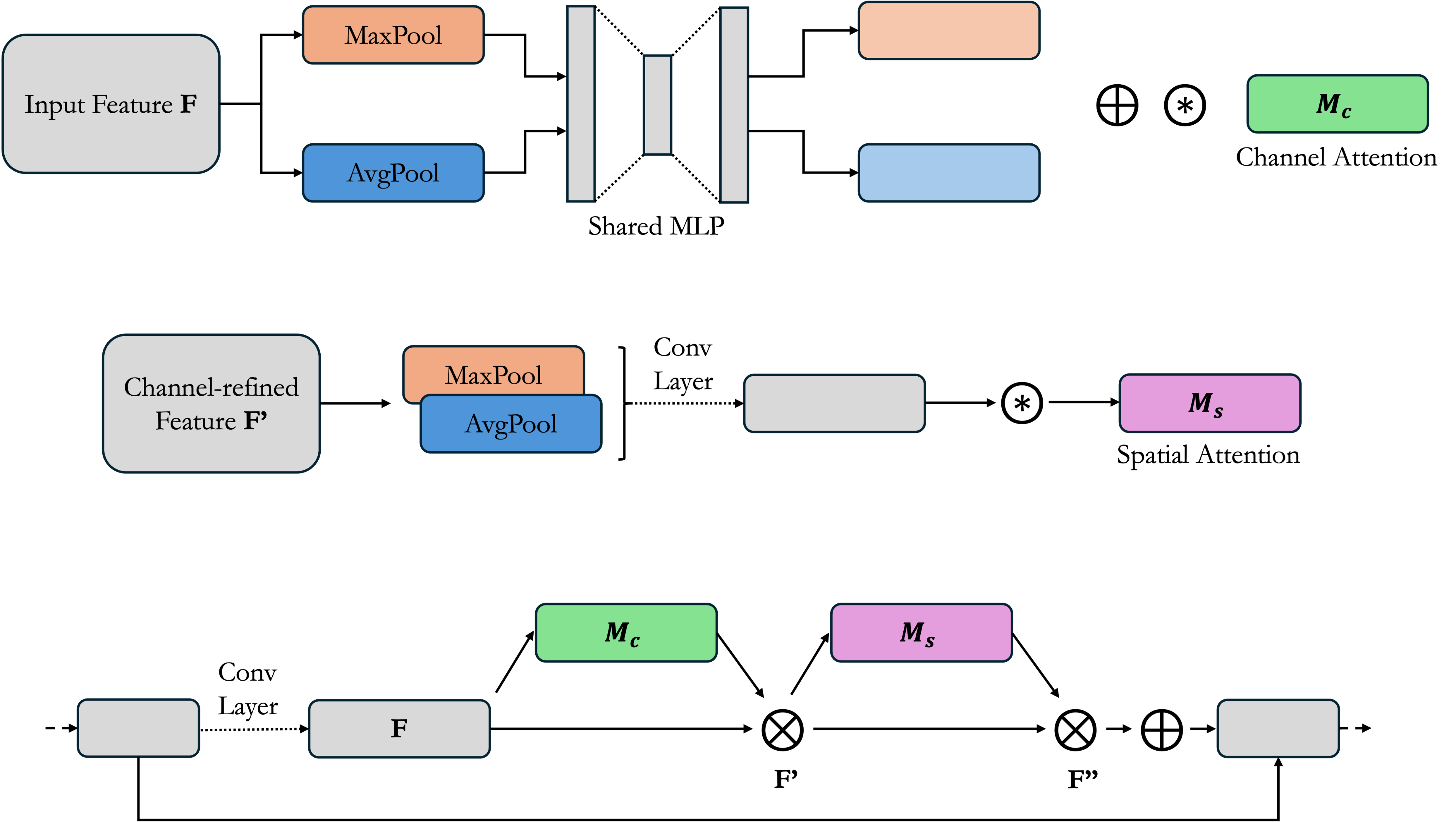
CBAM attention mechanism. Channel attention squeezes spatial dimensions via global average and max pooling, combines them through a shared MLP, and produces per-channel gating weights. Spatial attention then pools across channels and applies a convolutional attention map to focus the network on the merger time–frequency region.
Feature pooling and output
After the final residual stage, the backend output (B, C, H, W) is pooled to a
fixed 512-dimensional vector:
# Inside MSCNN1D_2DResNetCBAM_Heteroscedastic.forward():
features = self.backend(cnn_output)             # (B, C, H, W)
features = self.flatten(self.avg_pool_1d(features))   # (B, 512)
AdaptiveAvgPool1d with output size 512 collapses the spatial
dimensions regardless of the input time length. This makes the network independent
of the compressed sequence length, which varies with the mass prior.
The 512-dimensional feature vector is shared between all output heads (ranking statistic + one head per regression target).
Input format
The backend expects a 4D tensor (B, n_detectors, C, T_down), which is the
concatenated frontend output. For a 2-detector run with filters_start=32, the
frontend produces 128 channels after Stage 3, so the backend input shape is
(B, 2, 128, T_down).