Frontend: Multi-Scale 1D CNN
The frontend processes each detector’s compressed time-domain waveform independently and converts it into a 2D feature map that the backend ResNet can consume.
The two key classes are ConcatBlockConv5
(a single multi-scale inception block) and
ConvBlock (three stages of those blocks
with downsampling).
ConcatBlockConv5 — the multi-scale block
Each ConcatBlockConv5 applies five
parallel 1D convolutions at different kernel scales and concatenates their outputs
together with the identity skip connection:
input ──┬── Conv1d(k)    ──┐
        ├── Conv1d(2k)   ──┤
        ├── Conv1d(k//2) ──┤── cat ── Conv1d(1)  ── output
        ├── Conv1d(k//4) ──┤
        ├── Conv1d(4k)   ──┤
        └──────────────────┘  (identity)
All convolutions use padding='same' so that every branch produces the same time
length as the input. The five branches capture features at very different time scales:
k//4 resolves fast oscillations near merger, while 4k integrates over long
inspiral trends. The final 1×1 pointwise convolution fuses the concatenated channels.
Each conv–BN–SiLU sequence uses Conv1dSame
so no manual padding calculations are needed.
ConvBlock — the per-detector frontend
ConvBlock stacks three stages of paired
ConcatBlockConv5 blocks with spatial
downsampling between stages:
input (1, T)
    │
Stage 1: ConcatBlock(k) + ConcatBlock(k//2+1) → MaxPool1d(8)
    │
Stage 2: ConcatBlock(k//2+1) + ConcatBlock(k//4+1) → MaxPool1d(4)
    │
Stage 3: ConcatBlock(k//4+1) + ConcatBlock(k//4+1)
    │
unsqueeze → (1, C, T_down)  — 2D feature map
The unsqueeze at the end adds a height dimension so the output is a 2D image
(batch, 1, channels, time_compressed) suitable for the 2D ResNet backend.
One ConvBlock is instantiated per
detector, and the outputs are concatenated along the channel dimension before being
passed to the backend:
H1 frontend output  (B, 1, C, T_down)
                                        → cat → (B, n_det, C, T_down)
L1 frontend output  (B, 1, C, T_down)
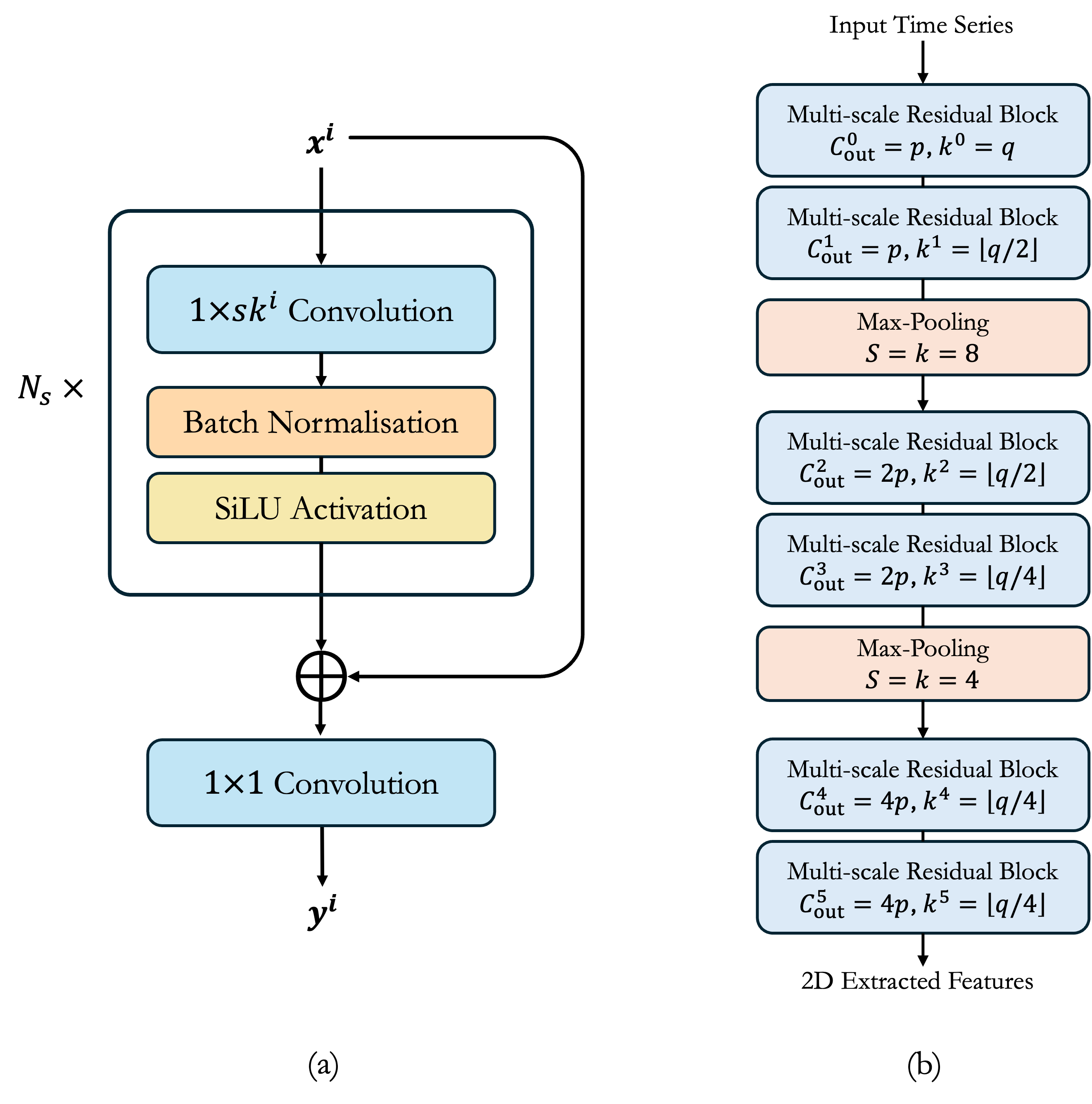
(a) A single multiscale residual block. The input \(x^i\) is analysed
simultaneously by \(N_s\) parallel 1D convolutions with kernel sizes
\(sk^i\), where \(s\) is a set of constant prefactors applied to the base
kernel size \(k^i\); outputs are element-wise summed (\(\oplus\)) with a
skip connection. (b) The full frontend architecture: three stages of paired
multiscale blocks with progressive spatial downsampling, one
ConvBlock per detector.
Parameters
Parameter |
Default |
Effect |
|---|---|---|
|
32 |
Base filter count. Stage 1 outputs 32 channels, Stage 2 64, Stage 3 128. |
|
64 |
Base kernel size |
|
1 |
Input channels per detector (always 1 for the compressed waveform). |
Weight initialisation
_initialize_frontend_weights() applies
Kaiming-normal initialisation to all Conv1d layers, ones/zeros to all
BatchNorm1d layers, and small-normal initialisation to all Linear layers.
It is called automatically on construction.