On-the-Fly Data Generation Pipeline
Sage generates every training batch from scratch at runtime — no fixed dataset is stored on disk. This page shows how to assemble the two data generators (signal and noise) into a self-contained pipeline that produces ready-to-use frequency-domain batches at each call.
The full pipeline for one batch is:
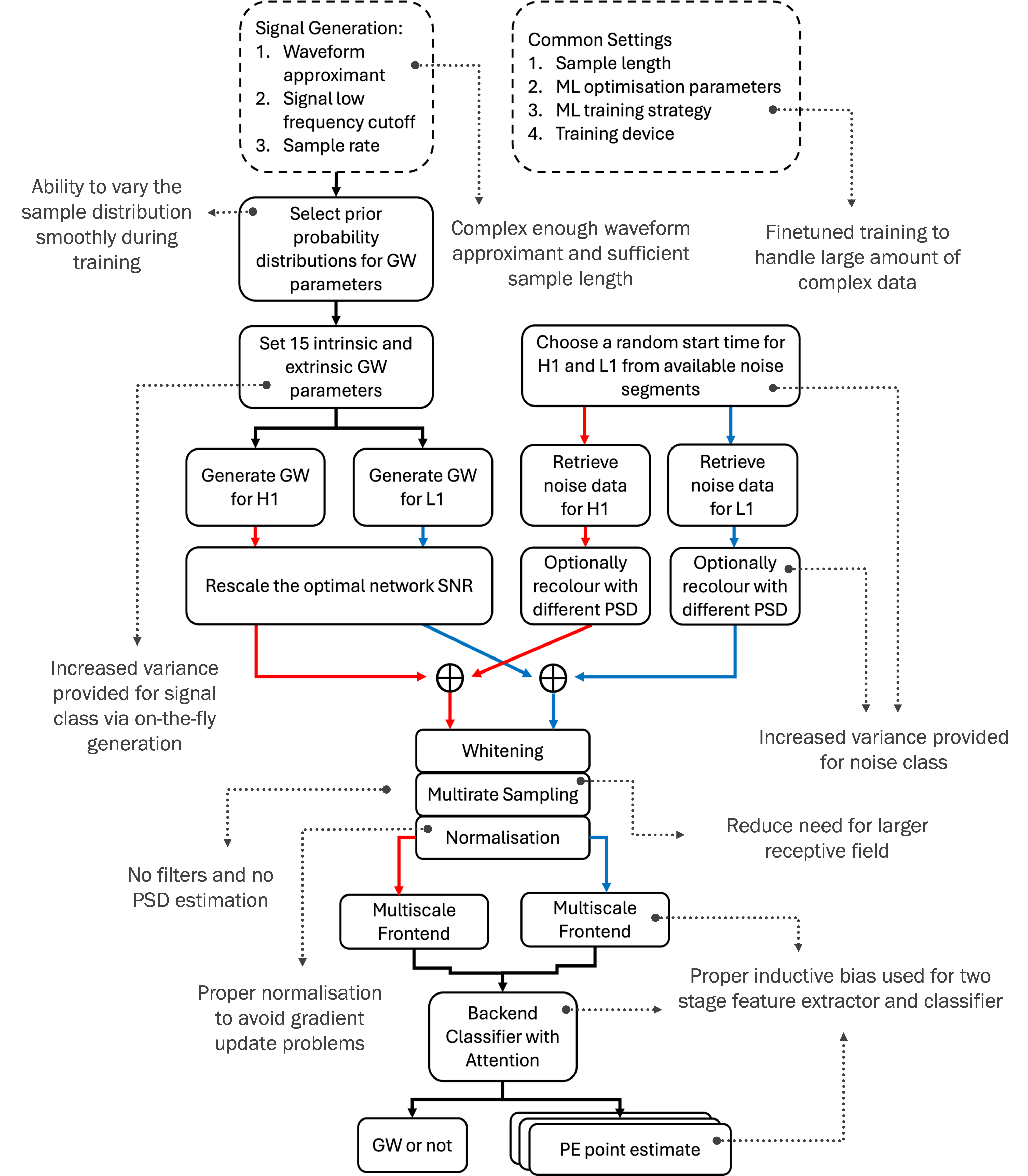
Flowchart of the Sage on-the-fly generation pipeline. Elements in the dotted box (configuration and data priming) are set once per run. The signal generation branch is specific to the signal class; common settings apply to both signal and noise. All boxes with solid outlines are iterated over at every training batch.
Signal sampler with SNR rescaling
The SNR rescaler draws a target SNR from a half-normal prior and rescales each waveform amplitude to match it before injection. This controls the SNR distribution of the training set independently of the distance prior.
from sage.data.waveform import read_from_config, ConstantProjection, IMRPhenomPv2
from sage.data.waveform import HalfNorm
from sage.data.waveform.snr import OptimalSNRRescaler

# Parameter prior from YAML
param_sampler = read_from_config("./gwconfig.yaml", seed=150914)

# Sky/polarisation projection (constant in time)
waveform_project = ConstantProjection()

# SNR prior: half-normal with loc=5, scale=4 → most injections SNR 5–20
target_snr_sampler = HalfNorm(scale=4.0, loc=5.0, seed=150914)
snrscaler = OptimalSNRRescaler(target_snr_sampler)

# Combine into a signal sampler with automatic SNR rescaling
signal_sampler = IMRPhenomPv2(
    param_sampler,
    waveform_project,
    augment=snrscaler,   # <— rescaling applied after waveform generation
)
Calling signal_sampler() returns a (signal_data, signal_targets) pair:
signal_data, signal_targets = signal_sampler()
# signal_data:    (S, n_detectors, n_freq)  — complex FD strain, rescaled
# signal_targets: (S, num_pe + 1)           — regression targets + class label (1)
where S = batch_size * class_balance (default 50% of the batch).
Changing the SNR distribution
HalfNorm(scale=s, loc=l) draws from a half-normal with lower bound l and
spread s. To target louder injections (e.g. for early training):
target_snr_sampler = HalfNorm(scale=8.0, loc=8.0, seed=150914)
To inject at a single fixed SNR:
from sage.data.waveform.distributions.snr_rescaling import FixedSNRRescaler
snrscaler = FixedSNRRescaler(target_snr=10.0)
Noise sampler with recolouring
The noise sampler loads batches from the pre-downloaded .bin files and optionally
recolours them to a PSD drawn from the recolouring library.
from sage.data.noise import MemmapNoiseSampler, RecolourPostprocess

recolour = RecolourPostprocess(
    p_recolour=0.37,                              # 37% of batches are recoloured
    recolour_dataset_dir="/path/to/data_dir",     # contains recolour_psds/ and fiducial_psds/
)

noise_sampler = MemmapNoiseSampler(
    postprocess_fn=recolour,
    prefetch=8,
    seed=150914,
)
noise_sampler() returns a (noise_data, noise_targets) pair:
noise_data, noise_targets = noise_sampler()
# noise_data:    (B, n_detectors, n_freq)  — complex FD noise (whitened, FD)
# noise_targets: (B, 1)                   — class label (0 = noise)
Disabling recolouring (e.g. for validation):
noise_sampler_val = MemmapNoiseSampler(
    postprocess_fn=None,   # no recolouring — use fiducial whitening only
    prefetch=8,
    seed=170817,
)
Assembling a full batch manually
The training loop injects signals into random noise positions:
import torch

cfg = get_cfg()
B = cfg.batch_size                          # total batch size
S = int(B * cfg.class_balance)             # number of signal slots (default 50%)

signal_data, signal_targets = signal_sampler()
noise_data,  noise_targets  = noise_sampler()

# Random injection positions
idx = torch.randperm(B, device=cfg.device)[:S]

signal_pad = torch.zeros_like(noise_data)
signal_pad[idx] = signal_data              # inject into selected noise slots

combined = noise_data + signal_pad         # (B, n_det, n_freq) — FD strain
The combined tensor is now a mixed batch: S slots contain signal+noise, the
remaining B-S slots contain pure noise. This is the input to the preprocessing
pipeline described in Data Transforms.
Controlling randomness and reproducibility
Every random process in the pipeline is seeded:
Component |
Seed argument |
|---|---|
|
Seeds the |
|
Seeds the SNR prior sampler. |
|
Seeds the noise index selection. |
Use different seeds for training and validation to ensure the two streams never
overlap. The O3b run uses seed=150914 for training and seed=170817 for
validation throughout.